

Meaning-Based Coaching: Why Most Culture Work Fails
Meaning based coaching rests on a single reversal that changes the dynamic of how we look at organisational culture and personal development in what I think is a profoundly meaningful way.
Performance based coaching takes a personal or professional goal as settled and works on the route towards an outcome. Meaning based coaching examines the goal itself, asking what would make an outcome worth pursuing in the first place. It draws on logotherapy, existential philosophy, narrative identity theory, humanistic and coaching psychology, and follows Frankl in treating meaninglessness as a condition in its own right rather than a symptom of something else.
I believe firmly that the conceptual base is fundamental for anyone holding responsibility within organisational culture, and here’s why.
The Three Parts of Meaning
Frank Martela and Michael Steger (two meaning-in-life researchers) argued that what we group together as meaning really consists as three separable components.
Coherence is the sense that events hang together in a way a person can follow. Purpose is the sense of direction and significance is the sense that one’s existence registers or matters. A simple observation at first glance, but these feel almost identical from the inside and they call for entirely different work on the outside.
A workforce that has lost coherence through restructure will not be served by a purpose campaign, and a team with abundant direction and no felt significance will read that campaign as HR noise.
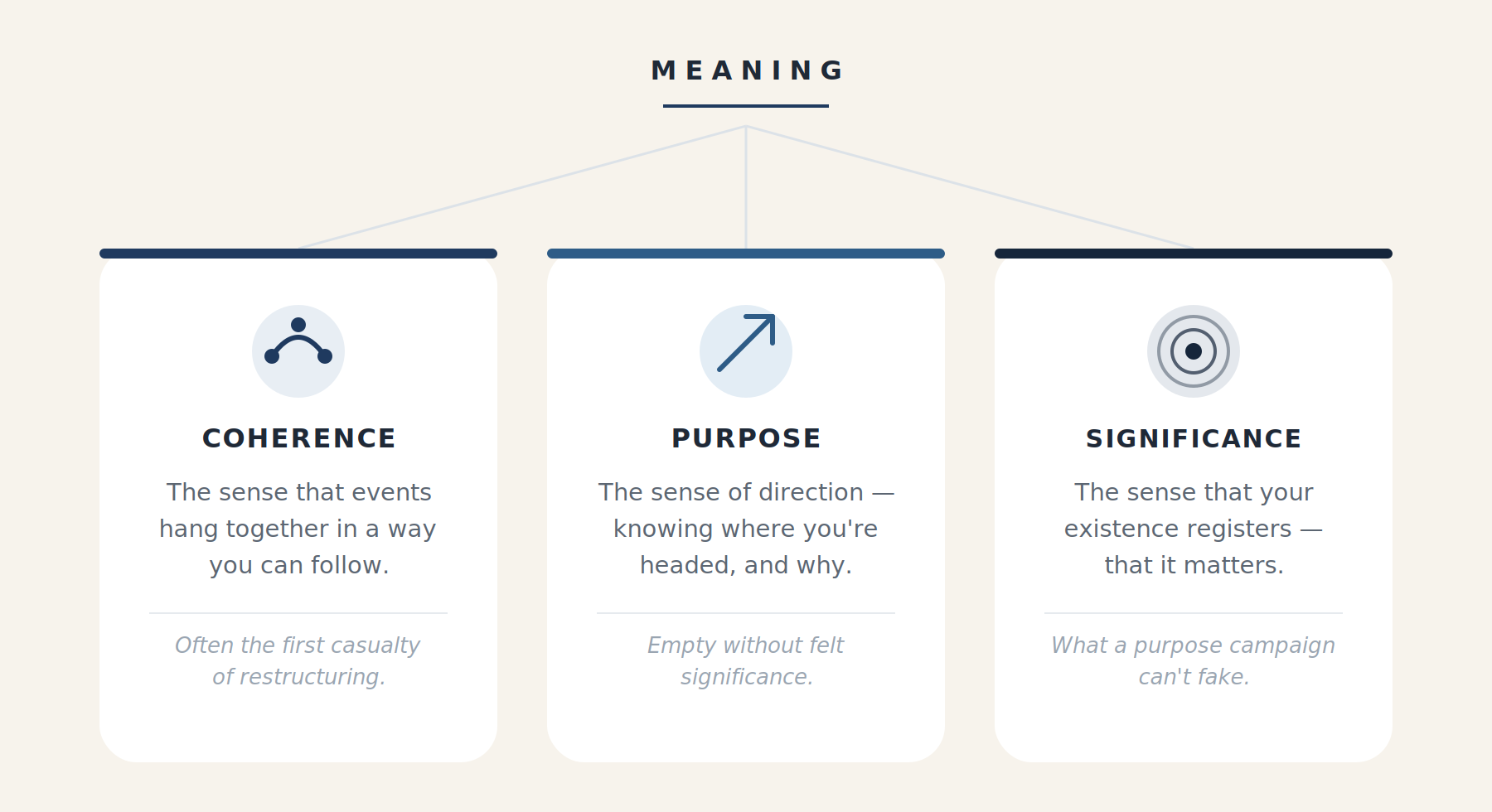
Martela and Steger's three components of meaning.
Why Meaning Can’t Be Installed
The second principle is that meaning is discovered rather than installed. Frankl (who pioneered logotherapy) held that meaning given by someone else carries no weight under pressure, because the person has no relationship with it and cannot return to it. This is why values statements can quickly turn into a workplace pun. The organisational task is therefore the creation of conditions rather than the issuing of declarations.
The empirical picture supports that emphasis in a way that isn’t as complicated as it sounds, but is however, in my opinion, fascinating. Christina Maslach (a social psychologist and professor emerita of psychology at UC Berkeley, and the pioneering researcher on job burnout) identified a values mismatch between person and organisation as one of the strongest predictors of burnout, which is why people can sustain heavy workloads with their wellbeing intact when the work signifies something meaningful and struggle with burnout under lighter ones when it does not.
Catherine Bailey and Adrian Madden (UK organisational researchers, from King’s College London and the University of York) studying meaningful work across occupations, found that leaders were considerably more capable of destroying meaningfulness than generating it, through unnecessary bureaucracy, unfair treatment, disconnection from outcomes and work regarded as pointless.

How Culture Coaching Works in Practice
Culture coaching applies this diagnostically. It asks which component of meaning has gone missing, where the organisation is cancelling it, and what leaders take their own work to be for before they are asked to be a source of purpose for anyone else.
In practice that runs as a full day opening workshop, where leaders and junior staff sit in mixed groups and discuss what rewriting job roles, the culture deck and the company policies together would sound like, followed by six one to one culture coaching sessions each, and closing with a half day where leaders are re-interviewed and the changes made get reviewed honestly.
What comes out of it, in my experience, is a workforce that can say out loud what its work is actually for, and leaders who know exactly which parts of the operation are cancelling that out.
“A well maintained organisation and an inhabited one look almost identical from the outside, and the difference is whether anyone is living in the rooms.”
Culture coaching is the work of finding out which one you are actually running, and doing something honest about the answer.
Most leaders already know where the incoherence sits in their organisation, and what they have rarely had is an honest, carefully crafted space in which saying it out loud was psychologically safe enough to be open and accessible enough to bring a workplace culture together in a meaningful way afterwards.
If you are a Senior leader, CEO, founder, CFO or director and are curious about what one honest coaching conversation could do for your organisation's culture. You can check out our pilot program here.