
Think back to your last appraisal or development conversation. How much of it was about what you do brilliantly, and how much was about your "areas for development"?
For most of us, it's the second one. We learn early on that growth means finding the gaps and filling them. The subject you struggled with got the extra tutoring; the one you loved got a nod and was quietly forgotten. We carry that habit into work, into appraisals, and into how we talk to ourselves.
It feels responsible. But it may be holding us back.
There's a story behind the name Wagtail. Every morning, a wagtail tapped at our bedroom window, fighting its own reflection. It was determined, persistent and completely undeterred, but all that energy was aimed at the wrong thing. So many of us do the same, spending our best energy battling the parts of ourselves we think are lacking. Imagine what that determination could do if it were pointed at what we already do well.
What the research tells us
Gallup has studied strengths at work for more than two decades, and the findings are hard to ignore:
People who use their strengths every day are six times more likely to be engaged in their work.
Teams that focus on strengths every day show 12.5% greater productivity.
When a manager focuses mainly on someone's weaknesses, the chance of that person being actively disengaged rises to 22%.
More recent research points the same way. In a 2024 study published in Current Psychology, Bratty and Dennis found that short workplace strengths interventions led to significant gains in job performance and work engagement. The key detail: the benefits appeared when people actually increased how much they used their strengths day to day. Knowing your strengths is a great start, but using them is where the change happens.
Put simply, we grow fastest where we already have energy.
Strengths are about energy, not just ability
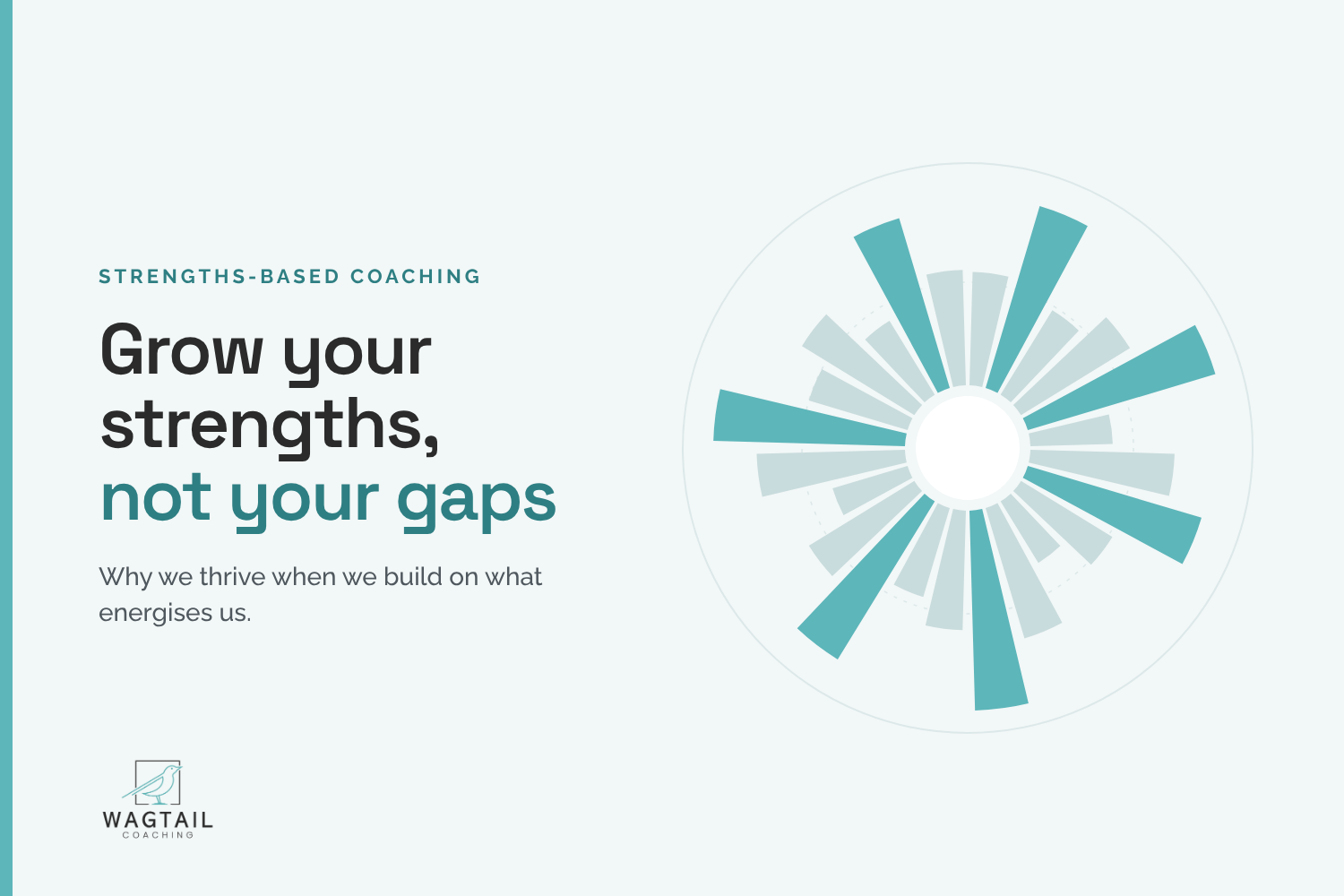
Here's the part that surprises many people. A strength isn't simply something you're good at. Strengthscope defines strengths as the underlying qualities that energise you, and that you're great at or have the potential to become great at.
That difference matters. Most of us can think of something we do well that still leaves us drained: the meticulous report, the endless coordinating, the constant people-pleasing. Strengthscope calls these energy drainers. You might be skilled at them, but doing them all day slowly wears you down. It's often why a role can look perfect on paper and still feel wrong.
Strengths have a shadow side too. A strength used too much, or at the wrong moment, can tip into what Strengthscope calls overdrive:
Decisiveness can become steamrolling.
Compassion can become carrying everyone else's problems.
Attention to detail can become perfectionism.
So developing your strengths isn't just "do more of what you love". It's understanding what energises you, where it serves you, and where it might be getting in your way. Strengthscope's rule of thumb is to spend roughly 80% of your energy using and growing your strengths, and 20% managing the risks. Weaknesses don't disappear; they just stop running the show.
Leading from your strengths
One of my favourite leadership books is Anthony Gell's The Book of Leadership. Drawing on interviews with some of the world's most successful leaders, Gell shows that great leadership starts with leading yourself, and a big part of that is knowing your strengths and building on them, rather than fixating on what you're not.
The same is true for teams. No one is brilliant at everything, and great teams don't need everyone to be. A team of people each working from their strengths, and covering for one another's gaps, is far more powerful than a team of well-rounded people who are all a bit tired.
When leaders understand what energises each person, delegation stops being about who has capacity and starts being about who will genuinely thrive on the task. Work gets done better, and people feel seen.
Five ways to start developing your strengths this week
Notice your energy. For one week, jot down the moments when time flies and the moments when you're watching the clock. Patterns will appear quickly.
Ask people who know you. Ask two or three colleagues or friends: "When have you seen me at my best?" Their answers are often surprising, and kinder than the stories we tell ourselves.
Shape your work around what energises you. Look for small ways to do more of what lights you up, whether that's volunteering for a project, swapping a task with a colleague, or changing how you approach a routine job.
Manage your drainers to "good enough". You don't have to love every task. Batch the draining ones, share them where you can, and stop expecting yourself to excel at everything.
Watch for overdrive under pressure. When stress rises, our strengths can tip too far. Knowing your own early-warning signs helps you dial back before they get in the way.
Discover your strengths with a Strengthscope assessment
If you'd like a clearer picture of your own strengths, I'd love to help. I offer Strengthscope assessments: a practical, science-backed tool that measures 24 qualities most closely related to performance at work, identifying what energises you and what drains your energy.
It starts with a short online questionnaire, followed by a 90-minute, one-to-one coaching conversation with me. You'll come away with:
Your top 7 strengths, the qualities that energise you most
Your energy drainers, the work that wears you down, even when you're good at it
Your overdrive risks, and practical ways to manage them
Clear next steps for using more of what you do best, every day
It's especially helpful if you're at a career crossroads, stepping into leadership, or in a role that looks fine on paper but doesn't quite feel right. I also offer a six-session Lead from Your Strengths coaching programme, and StrengthscopeTeam workshops for teams.
Book your strengths assessment
Not sure yet? Get in touch for a free, no-pressure 30-minute chat.
When were you last at your best at work, completely absorbed, time flying? What strength were you using in that moment, and how could you use it a little more this week?
References
Gallup. Why nurturing employee morale is crucial to business success
Gallup. Employees who use their strengths outperform those who don't
Bratty, A. J. and Dennis, N. C. (2024). The efficacy of employee strengths interventions on desirable workplace outcomes. Current Psychology, 43, 16514–16532.
Gell, A. (2014). The Book of Leadership. Piatkus. Publisher page
Strengthscope. Strengths and emotional intelligence